From concept to completion, a unified structural and civil engineering service for commercial basements
Commercial basements offer significant value: additional storage, plantrooms, underground parking, extra office space or retail below grade. At SWJ Consulting we bring together both our structural-engineering expertise and our civil-engineering capability to deliver these complex projects with clarity, efficiency, and risk-control.
Working with an integrated structural and civil engineering team
Structural engineering focuses on foundations, load-paths, wall and slab design; the civil engineers examine groundworks, drainage, groundwater control, site infrastructure and earth-retention. Together, we can coordinate all sub-structure interfaces more efficiently than using multiple consultancies.
SWJ Consulting’s structural and civil teams will collaborate from day one delivering a number of key advantages to our clients:
- Reduced risk on ground and water: Building below ground typically involves more complex ground conditions, groundwater, excavation support, temporary works and interface with adjacent structures. With both civil and structural teams involved, site and geotechnical risks are assessed collectively. Our civil team will evaluate drainage routing, and cut/fill geometry, while our structural team will evaluate how those conditions affect retaining walls, slabs and load-transfer zones.
- Optimised construction sequencing and cost-control: Early collaboration allows the team to align excavation, temporary works, slab and wall construction, waterproofing and services. This can avoid re-works, clashes between groundworks and structural elements, and help manage the programme.
- Single point of accountability and smoother delivery: Rather than the client having to coordinate separate consultants, we provide a combined service – so the structural and civil engineers are already working together, using consistent models, assumptions and communication channels.
- Better constructability and interface with contractors: On many commercial basement projects the civil and the structural work overlap heavily. Our integrated approach ensures the contractor receives a clearer and coordinated package.

Construction Sequence – Our approach to your commercial basement
Site and Ground Investigations
We start with a full investigation of the ground, groundwater, adjacent structures and site constraints. Our civil team completes or reviews geotechnical boreholes, groundwater monitoring, site access, existing service diversions and temporary works requirements. The structural team then assesses how these findings affect foundations, basement wall types, slab thicknesses and uplift/earth-pressure loads.
Engineering and Concept Design
With all the data from the initial investigations, the structural team can define the loadings for the basement, evaluate retaining wall types, slab and beam design and integration with the above-ground structure. Simultaneously, the civil team assesses earth-retention options, drainage strategy, site grading, external works and access. Together we will generate a design that is optimised both structurally and civilly.
Construction Method & Temporary Works Planning
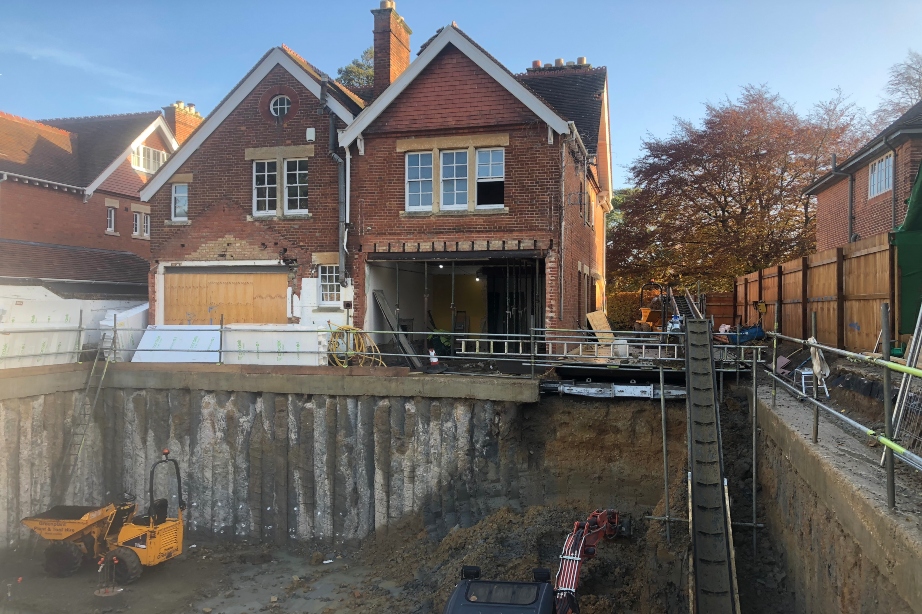
Basement construction is inherently more challenging than standard above-ground works. Issues of excavation stability, adjacent building support, water ingress and complex temporary works must be managed. We ensure the temporary works, excavation support, slab construction, waterproofing and services are all aligned.
Drainage, Waterproofing & Infrastructure
Our civil team develops the basement’s external and internal drainage scheme, groundwater control, and infrastructure connections (stormwater, foul, service routes). The structural team ensures that slabs, walls and foundations are designed to cope with hydrostatic pressure, uplift and soil loads. Water-ingress management is a core component of modern basement design.
Services Integration & Fit-out Co-ordination
Commercial basements often house plantrooms, M&E services, parking or speciality uses. We collaborate with M&E engineers to ensure appropriate clearance, structural capacity, slab penetrations, access and maintenance routes. The civil/structural partnership means that the basement shell is delivered with services coordination built-in rather than as an after-thought.
Delivery, Monitoring & Handover
During the construction phase we can monitor ground movement, water levels, retaining wall performance, temporary works, slab cure, etc. Post-construction, the handover includes structural/civil documentation, drainage and waterproofing records, utilities and any required warranties, all coordinated under our combined service.
What this means for our clients
- Fewer consultants to manage. Simpler communications and reduced risk of disconnect between disciplines.
- Faster decision-making. Any ground, structural, or civil issues will be flagged early and will be resolved in-house.
- Cost-efficient design. By evaluating civil and structural information together we avoid over-engineering or duplicated risk mitigation.
- Robust delivery. Our combined approach means fewer surprises on site, better control of excavation, improved stability and reduced groundwater issues, which are often the cause of basement budget and programme problems.
By choosing SWJ Consulting you engage a multi-discipline team for your commercial basement project – not just structural engineering, but full integration with our civil engineering resource. We believe this partnership is the difference between a standard basement build and an optimised and risk-controlled underground development.