

When designing foundations for any structure ground conditions play a crucial part in determining which foundation solution will be best, to create a stable base for the structure. When dealing with weak or compressible soils, traditionally dug deep foundations may not always be the most cost-effective or feasible solution. Digging trenches into loose soil may cause the side walls to collapse, which can be dangerous, and loose soil is given to movement which could lead to subsidence.
When dealing with poor ground conditions one specialised ground improvement technique that we can use to enhance soil stability is known as ‘rigid inclusions’.
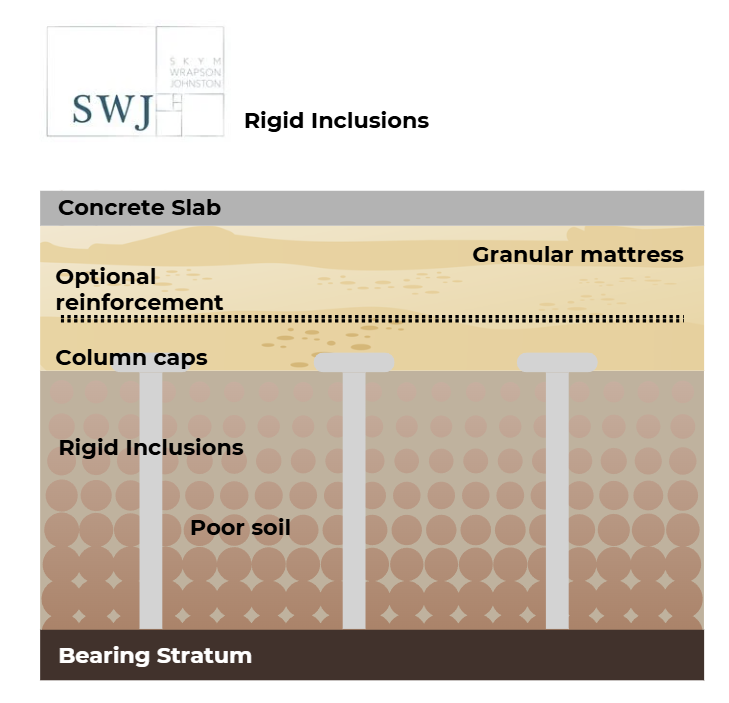
Rigid inclusions are vertical columns made of stiff materials, such as cement-treated soil or concrete, that are installed into weak ground to improve their load-bearing capacity. Unlike traditional piled foundations, rigid inclusions do not transfer loads directly to bedrock. Instead, they work by reinforcing and strengthening the existing soil, distributing structural loads more effectively. Often, a granular mattress or reinforced load transfer platform is placed above the inclusions to further distribute the load (see illustration)
We might recommend rigid inclusions for a variety of construction scenarios, particularly where poor soil conditions require improvement.
Advantages of Rigid Inclusions
Rigid inclusions are generally more cost-effective than traditional piled foundations as they require less material and less excavation. There is less soil displacement so there is a reduced need for concrete and steel. They can be used in a wide range of soil conditions and project types, making them incredibly versatile.
The improved stability of the ground created by rigid inclusions reduces differential settlement and greatly enhances soil load capacity.
Rigid inclusions provide an effective and sustainable solution for improving weak ground conditions in many types of construction projects. By enhancing soil strength and distributing loads efficiently, this technique means we can avoid expensive deep-piled foundations.
As the demand for cost-efficient and more environmentally friendly ground improvement methods increases, we expect rigid inclusions to remain a popular ground improvement solution.
If you are struggling with poor ground conditions on a project give SWJ Consulting a call on 01993 225085 (Oxfordshire) or 02381 920656 (Southampton) or email mail@swjconsulting.co.uk.